
SCREEN DEPENDENCE & DIGITAL OVEREXPOSURE
When the Screen Starts Controlling the Child
A child picks up a phone to watch one video.
Then another.
Then another.
A few minutes become an hour.
An hour becomes a habit.
And gradually, the screen begins to occupy the space that once belonged to sleep, play, reading, conversation, creativity, curiosity and real-world experiences.
This is not simply a question of screen time.
It is increasingly a question of attention, behaviour, sleep, emotional regulation, physical activity and the way a young mind learns to engage with the world.
The challenge is no longer limited to teenagers.
Digital overexposure can begin very early in life and continue through childhood, adolescence and adulthood.
For younger children, screens can displace interactive play, conversation, reading and physical activity. For older children and teenagers, continuous digital engagement may compete with sleep, study, exercise, relationships and sustained attention.
The World Health Organization recommends avoiding sedentary screen time for 1-year-olds and limiting it to no more than one hour for 2-year-olds; for children aged 3–4, the recommendation is no more than one hour, with less being better.
WHAT HAPPENS WHEN DIGITAL EXPOSURE BECOMES EXCESSIVE?
The concern is not that technology itself is harmful.
Technology is a tool.
The concern begins when technology starts replacing essential human experiences.
Excessive or poorly timed digital engagement may contribute to:
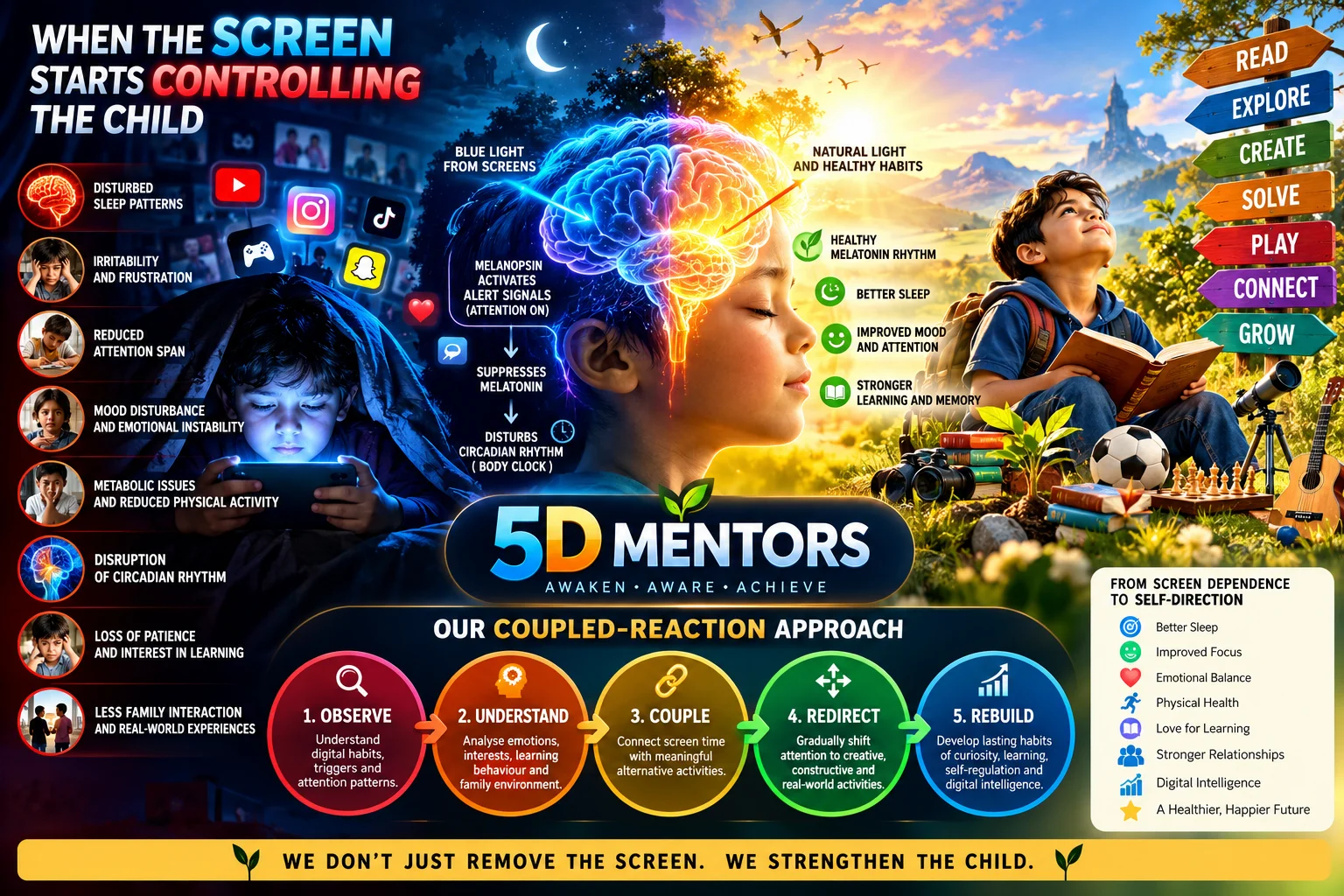
- Disturbed sleep patterns
- Reduced physical activity
- Difficulty sustaining attention
- Irritability and frustration
- Emotional dysregulation
- Reduced patience for challenging tasks
- Displacement of reading and creative activities
- Increased sedentary behaviour
- Difficulty disengaging from digital content
- Disruption of family interaction
- Reduced opportunities for real-world problem solving
Research and public-health guidance particularly highlight the relationship between sedentary behaviour, recreational screen use, sleep and physical health in children and adolescents.
THE HIDDEN CONNECTION: SCREEN, LIGHT & THE BODY CLOCK
Our body does not function randomly.
It operates through highly coordinated biological rhythms.
One of the most important is the Circadian rhythm — the approximately 24-hour biological timing system that helps coordinate sleep, wakefulness and many physiological processes.
Light is one of its strongest environmental signals.
Specialised retinal cells containing Melanopsin detect light and communicate with the brain's circadian system. The pathway ultimately influences the suprachiasmatic nucleus (SCN), an important master circadian pacemaker.
This becomes particularly relevant at night.
Short-wavelength light can be especially effective at suppressing melatonin and shifting circadian timing. Screen exposure close to bedtime can therefore contribute to delayed sleep and poorer sleep quality. However, the effect is not caused by blue light alone: content, emotional arousal, notifications, bedtime displacement and device habits also matter.
In simple words:
The brain needs signals that tell it when to be alert — and when to wind down.
Constant digital stimulation can interfere with that transition.
WHY 5D MENTORS DOES NOT BELIEVE IN A SUDDEN "NO SCREEN" SOLUTION
Simply taking the phone away may stop access.
It does not necessarily change the underlying behaviour.
A child who has become accustomed to continuous stimulation may simply look for another source of stimulation.
That is why 5D Mentors follows a gradual, behaviour-focused approach.
We do not aim merely to remove the screen.
We aim to make the real world more engaging than the screen.
OUR SCIENTIFICALLY INSPIRED APPROACH:
THE COUPLED-REACTION MODEL
Inspired by the concept of a coupled reaction in chemistry, 5D Mentors uses a structured behavioural approach in which one desired activity is progressively connected with another.
Instead of treating screen use as an isolated problem, we look at the behavioural pattern surrounding it.
STEP 1 — OBSERVE
We understand:
- When does the child reach for the screen?
- What type of content attracts them?
- What emotions precede screen use?
- What happens when the device is removed?
- Is the child seeking entertainment, stimulation, connection, escape or achievement?
- What activities have gradually disappeared from daily life?
STEP 2 — UNDERSTAND
We identify the child's:
Attention patterns
Emotional triggers
Digital habits
Interests
Learning behaviour
Sleep routine
Physical activity
Family environment
The objective is not to label the child.
The objective is to understand the child.
STEP 3 — COUPLE
We progressively connect digital disengagement with meaningful alternatives.
For example:
Screen → Reading
Screen → Puzzle
Screen → Mathematics
Screen → Experiment
Screen → Art
Screen → Outdoor activity
Screen → Real-world challenge
Screen → Conversation
The replacement activity is selected according to the child's age, interests, abilities and behavioural pattern.
STEP 4 — REDIRECT
The child's attention is gradually redirected from passive digital consumption towards active engagement.
Instead of endlessly scrolling:
Think.
Instead of merely watching:
Create.
Instead of consuming:
Explore.
Instead of avoiding difficulty:
Solve.
Instead of reacting automatically:
Become aware.
STEP 5 — REBUILD
Over time, the objective is to strengthen the child's relationship with:
- Curiosity
- Reading
- Learning
- Creativity
- Physical activity
- Human interaction
- Problem-solving
- Emotional awareness
- Self-regulation
- Real-world experiences
The goal is not simply less screen time.
The deeper goal is more meaningful life time.
THE 5D MENTORS PHILOSOPHY
DON'T JUST REMOVE THE SCREEN.
REBUILD THE WORLD AROUND THE CHILD.
A child needs something more powerful than a prohibition.
A child needs:
Purpose.
Connection.
Challenge.
Curiosity.
Movement.
Creativity.
Recognition.
Meaning.
When meaningful engagement increases, dependence on passive digital stimulation can gradually become easier to address.
FROM SCREEN DEPENDENCE TO SELF-DIRECTION
5D Mentors works towards helping children move through a gradual journey:
Awareness → Observation → Engagement → Redirection → Self-Regulation
The ultimate objective is not to make a child afraid of technology.
It is to help the child use technology consciously rather than being controlled by it.
Because the future will not be screen-free.
The future will be technology-rich.
Therefore, children need something more important than digital avoidance.
They need DIGITAL INTELLIGENCE.
They need to understand:
When to use technology.
Why to use technology.
How much to use technology.
When to stop.
And what to do when the screen is switched off.
5D MENTORS
AWAKEN • AWARE • ACHIEVE
We don't fight the screen.
We strengthen the child.
Because the ultimate solution to digital overexposure is not merely taking technology away.
It is helping a child rediscover a world that is interesting enough to look up from the screen.


